
Fifty-two infants were hospitalized with botulism in two outbreaks seven months apart. Forty-eight of them had been fed ByHeart Whole Nutrition powdered infant formula. Four had been fed Nara Organics Whole Milk Organic. The two products were made by different companies, on different continents, under different quality systems. Before 2025, the FDA says, no botulism outbreak had ever been tied to infant formula anywhere in the world since infant botulism was first described about fifty years ago. Then two happened back-to-back.
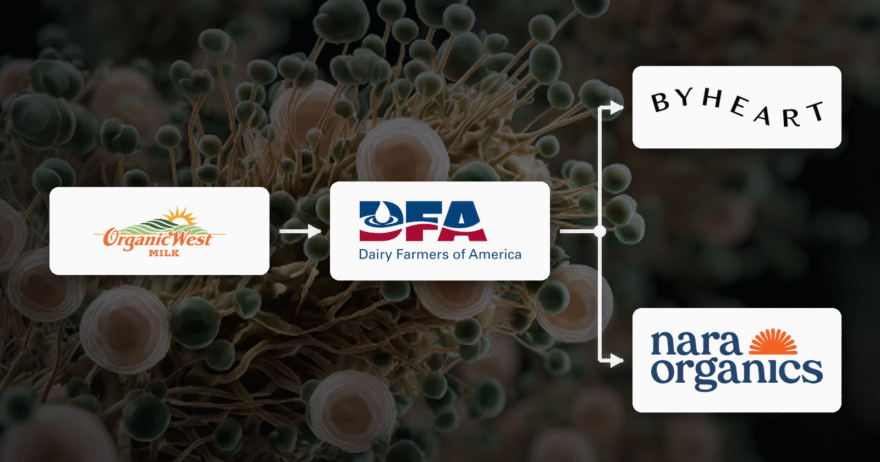
Whole genome sequencing has now tied them to each other, and both of them to one ingredient: organic whole milk powder brokered by Organic West Milk and spray dried by Dairy Farmers of America at its plant in Fallon, Nevada. That is the part of this record that matters most and has drawn the least attention.
The two outbreaks
CDC declared the ByHeart outbreak over on February 26, 2026: 48 infants — 28 confirmed and 20 probable — in seventeen states, all hospitalized, no deaths, with onsets from December 24, 2023 through November 29, 2025. It is the largest infant botulism outbreak ever documented in this country.
CDC declared the Nara Organics outbreak over on August 27, 2026: four confirmed cases in California (two), Pennsylvania and Washington, with onsets on April 20, May 17, May 20 and May 31, 2026. All four infants were hospitalized. Nara recalled all sixteen lots on the market on June 13, 2026, the day after FDA and CDC called on a Friday evening to say three babies were hospitalized.
What sequencing showed inside the ByHeart outbreak
FDA’s Human Foods Program sequenced 37 C. botulinum isolates from the ByHeart investigation — sixteen clinical and twenty-one from product — and sorted them into seventeen strains. Four of those strains connect infants directly to product or to ingredient. Two of them reach all the way back to the dryer:
Strain 11 links two FDA isolates from a Dairy Farmers of America milk powder retain, three ByHeart whole milk powder isolates, a ByHeart finished product isolate, an unopened can collected from an Arizona case household, and a New Jersey infant’s clinical isolate — all matching one another at a mean of 7.5 SNPs.
Strain 2 links a ByHeart finished product isolate from lot 251261P2, the lot most often reported by ill infants, to a second Dairy Farmers of America milk powder retain, at eight SNPs.
FDA collected 26 samples of its own and got two positives: a base mix retain from the Iowa plant that blends ByHeart’s powder, and a milk powder retain pulled at Dairy Farmers of America in Fallon. The New York State Wadsworth Center tested five samples and got two more — the unopened Arizona can, and a second Dairy Farmers of America retain. The agency’s own sampling put the outbreak organism in the dryer’s product.
The match that crossed brands
The finding that accompanied the Nara closeout on August 27 is the most consequential development in this record since ByHeart’s own outbreak was declared over.
FDA reported that sequencing of one clinical sample from a Nara infant matched a clinical sample from an infant in the 2025 ByHeart outbreak, a ByHeart powdered infant formula base sample, and four samples of unopened cans of ByHeart formula. CDC described the same result more generally: a patient sample from this outbreak linked to a patient sample, product samples and an ingredient sample from the ByHeart investigation. FDA then said outright that the matching sequencing results and the shared supply chain indicate a common source of contamination between the two outbreaks.
Read that match set again. Every counterpart in it is a ByHeart sample. A baby who never consumed a spoonful of ByHeart formula was colonized by a strain genetically indistinguishable from the one in ByHeart’s base powder and inside four sealed, unopened cans of ByHeart’s finished product.
Three things follow. Recovery of that organism from unopened cans forecloses any argument that contamination came from a home, a store, or a broken seal — it was in the product before the product left the manufacturer. The second outbreak is an independent check on causation that cannot be blamed on anything peculiar to one company’s plant, because the only route between those two infants is the dairy ingredient their formulas shared. And the persistence of one strain through that ingredient stream — across two manufacturers, across ByHeart’s entire recall, and across the closeout of ByHeart’s own outbreak — is the opposite of the isolated contamination a defendant needs to show.
Where the two chains meet
FDA’s internal incident record, obtained under FOIA, describes the ByHeart chain: liquid whole milk from twenty dairies is delivered to Dairy Farmers of America in Fallon, where it is spray dried into organic whole milk powder; Organic West Milk, acting as broker, ships that powder by third-party carrier to the Iowa blender that makes ByHeart’s base mix.
Nara’s own account of its supply chain puts it in the same position. From October 2024 to April 2025 Nara bought whole milk from Organic West, dried at Dairy Farmers of America in Nevada. That powder went into formula Nara made in Germany and sold here through Target stores, Target.com and Nara.com from July 2025 until the recall. CDC’s closeout states the traceback more broadly than FDA did in June: the formulas sold by both brands — not just the Nara lots tied to illness — were made with that milk and dried by that processor.
How the second outbreak was allowed to happen
During the ByHeart investigation, Organic West Milk gave FDA a customer list that failed to disclose that its milk was also going to the maker of Nara formula. On January 28 and February 3, 2026, FDA’s outbreak response network sent traceability assignments to six firms that had received Organic West lots of milk powder testing positive for C. botulinum, asking for all distribution of that powder to infant formula manufacturers over the prior two years. The result, in FDA’s words: none of the firms identified any infant formula manufacturers as customers that were supplied whole milk powder. Nara formula had been on sale for six months at that point. The first Nara infant got sick about eight weeks after the last assignment closed.
Nara was not in the dark. In late January 2026 the Associated Press publicly identified Organic West Milk and the Fallon plant as the source of the botulism-positive powder in the ByHeart outbreak — and quoted Dairy Farmers of America saying its powder met all required tests. Nara has acknowledged learning from those reports in early 2026 that it shared suppliers with ByHeart. By its own description it reviewed its lots, looked at its sulfite-reducing clostridia results, and left the formula on the market. Four babies were hospitalized over the following four months.
That indicator testing is the testing that failed. The FAO/WHO expert group that met in Rome in June 2026 concluded that hygiene indicators do not replace pathogen-specific testing, and the published analysis of ByHeart product found C. botulinum in finished formula and base powder where the usual indicator organism was non-detectable. Both companies in this chain pointed to their tests as proof of safety. The tests were the problem.
What sequencing settles, and what it doesn’t
FDA has not announced a root cause, and it cannot yet say whether the milk was contaminated before drying or during drying. Its preventive controls inspection at Dairy Farmers of America found no objectionable conditions, and its inspections of ByHeart’s plants turned up nothing that explains the outbreak.
Those are limits on origin, not on defect. Whether spores entered the milk on a farm, in a tanker, or in the dryer bears on how responsibility is apportioned among these companies, not on the condition of what was sold. The powder that left Fallon carried viable C. botulinum, and sequencing put that organism in two brands of finished formula and in sick infants in both outbreaks. A component manufacturer whose component is itself defective is liable for the harm the defect causes once the component is built into the finished product, and the broker who sold that powder into commerce stands where any other commercial seller stands. FDA told the whole industry as much in its July 13, 2026 letter: responsibility for safety extends to every ingredient, every supplier, and every link in the supply chain.
Two loose ends remain, and they are our first discovery requests. FDA reported on July 6 that C. botulinumhad been recovered from an open can of Nara formula fed to one of the sick infants, and that an unopened can from the same lot was being tested. Neither closeout reports that result, and no Nara product or ingredient sample is reported to have matched anything. Every counterpart in the cross-brand match is on the ByHeart side of the ledger. I would like to know why.